

Summary: We are several generations of warfare from that of Clausewitz. His first-generation warfare differs immeasurably from ours, in which atomic weapons limit State-to-State conflict and 4th generation warfare has become the dominate form of conflict. But many of the essentials of war are timeless, so its worthwhile to mine the classics for lessons to help us today. Here we look at one such effort.
.
Contents
- Review from the Marine Corps Gazette
- About the authors of the book
- About the reviewer
- Other reviews
- For more information about military theory
(1) Review from the Marine Corps Gazette
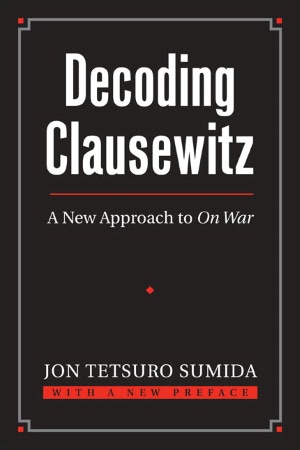
Decoding Clausewitz: A New Approach to On War
by Jon Tetsuro Sumida (2008)
Reviewed by J. Alex Vohr. Originally published in the Marine Corps Gazette, March 2009. Republished here with their generous permission.
Abstract
While primarily a naval historian, Dr. Sumidas decade-long foray into Clausewitz has resulted in a book uncovering issues significant to those whose professional interests involve either the formulation of our national military strategy or the professional education and development of military officers. Current prevailing wisdom holds that Clausewitz was concerned only with nation-state warfare, and modern military theorists like General Sir Rupert Smith, in his book, The Utility of Force (Vintage, 2008, reviewed in the August 2007 Gazette), have asserted that the Western world has seen the end of these types of conflicts.
Review
Dr. Jon Sumida is the author of the latest scholarly effort focused on understanding the difficult theorist of war, Carl von Clausewitz, and his work, On War. Decoding Clausewitz: A New Approach to On War provides a critical and potentially controversial, in-depth insight into the work of one of the most influential minds of the Western world. While primarily a naval historian, Dr. Sumida’s decade-long foray into Clausewitz has resulted in a book uncovering issues significant to those whose professional interests involve either the formulation of our national military strategy or the professional education and development of military officers.

Clausewitz’s On War heavily influenced the foundation of our military doctrine beginning in the post-Vietnam era and continuing until 11 September 2001 (9/11). In the wake of the wars resulting directly from 9/11, our doctrine writers and our professional military education institutions have largely abandoned serious consideration and study of On War.
Current prevailing wisdom holds that Clausewitz was concerned only with nation-state warfare, and modern military theorists like General Sir Rupert Smith, in his book, The Utility of Force (reviewed in the August 2007 Gazette), have asserted that the Western world has seen the end of these types of conflicts. Dr. Sumida, in his treatment of Clausewitz, simply invalidates these arguments. His highly credible intellectual efforts should resonate powerfully among those responsible for guiding our future through the development of national military strategy.
In Decoding Clausewitz, the author challenges a common understanding of On War as an unfinished text. Dr. Sumida views the text as a complete work at publication in which Clausewitz expresses fully supported arguments as opposed to what has before been viewed as a collection of incomplete thoughts. He furthermore challenges conventional wisdom of On War as a work describing the nature of war, arguing instead it is a theory of practice written for the practical reasons of illuminating the education of a nation’s military leadership.
Due to war’s nonlinear and unstable nature, Dr. Sumida suggests Clausewitz recognized no potential for a truly satisfactory theory for war. On War, Sumida argues, is not a book for understanding the phenomenon of war, but instead is a text in which Clausewitz presents two significant ideas. Clausewitz’s first assertion is that the defense is the strongest form of war. His second involves the combined use of history and theory for the study of war to inform the intuitive decision-making skills of military leaders.
Dr. Sumida focuses first on Clausewitz’s description of the relationship between the studies of history combined with the use of military theory to educate military officers. Sumida argues that Clausewitz understood history alone to be a flawed vehicle for understanding war. The most important insights into the psychology and decision-making of the commander were omitted in any historical effort to capture the chronological chain of events. Clausewitz, Dr. Sumida argues, a man who had thought long and hard about military education as a disciple of Scharnhorst and who had been a firsthand witness to the military genius of Napoleon, wrote of the combined use of history and a theory for the practice of war to provide experience for officers through reenactment. Sumida argues that On War was not written to be a description of the phenomenon of war, but instead provides a theory for the practice of war to fill historical gaps through surmise into the thoughts of the commander for the use of students of war.
This insight into the use of history and theory for the education of officers is profound and maintains as much relevance for military professionals today as it did when On War was written. Dr. Sumida focuses on Clausewitz’s prescription, not for war itself, but for informing, honing, and educating the intuitive decision-making capabilities of military commanders. In the past, and as will hold true in the chaotic future, the intuitive skills of the commander are the single most critical factor for success in war. The commander with the best intuitive feel for the battlefield will make the best decisions, no matter the character of war or the national status of the actors engaged.
The second major idea from On War identified by Dr. Sumida is the idea that, from a strategic perspective, the defense is the strongest form of war. Building on his original assertion that Clausewitz produced a complete work, and leveraging an understanding of Clausewitz’s personal experienced bases schema, Dr. Sumida argues that Clausewitz’s discussions of people’s war, absolute war, and limited war all build upon the foundation of the defense as the strongest form of war. Again, as with Sumidas description of Clausewitz’s use of historical reenactment, these ideas hold significant relevance in the security environment of our modern world. Dr. Sumidas assertions regarding Clausewitz’s insight are stunningly relevant today and should be carefully considered by those framing our national strategy for the long war. This is critical especially in relationship to topics such as preemption and our understanding of enemy employed concepts, such as offensive and defensive jihad.
Decoding Clausewitz bears the credibility of many years of scholarly effort. Dr. Sumida devotes his first chapter to comparing On War to the works of other military theorists to include Jomini, Corbett, and Liddell Hart, only one of whom was an advocate of Clausewitz’s ideas. He carefully explains their perspectives and in a balanced approach identifies their most significant influences. Dr. Sumidas second chapter examines the ideas of other contemporary Clausewitzian scholars, carefully chronicling their personal backgrounds and major arguments in contrast with his own. He searches for congruence in the independent thoughts of scholars while identifying concepts and ideas he considers to be inaccurate interpretations. These chapters clearly reflect the depth of Dr. Sumidas scholarly research and analysis underwriting the credibility of his total work.
In a chapter labeled “Antecedents and Anticipations,” Dr. Sumida examines Clausewitz himself from the perspective of his personal history in an effort to illuminate the many factors brought to bear in the writing of On War. Clausewitz is rightfully depicted as a man with unprecedented experience with war. He is shown as a soldier from an early age participating in and shaped by some of the most significant conflicts and battles of his age. His personal political challenges, coloring his perspective, come to light. Also communicated are his experiences with the great military educator Scharnhorst as well as his personal observations of the military genius of Napoleon. This chapter further examines and concludes with Clausewitz’s thoughts in light of the influence of both philosophy and science.
The book’s final chapter synthesizes Dr. Sumidas arguments regarding military education and the superiority of the defense. He carefully examines and cites On War as a complete text linking passage after passage to support his assertions. He demonstrates the coherence of On War as the life’s work of a man who knew war intimately and who spent an intellectual lifetime working to develop ideas that would be of practical use to preparing his nation for war. In this chapter Dr. Sumida provides previously unexpressed clarity into On War. He organizes for the reader ideas previously incomplete or without context. Through his efforts and without oversimplification, Dr. Sumida has made a complete understanding of Clausewitz’s idea accessible, contrasting conventional understanding gained through past scholarship.
Dr. Sumidas objective in writing his book was to “make Clausewitz accessible to general readers and military professionals alike in a form that does justice to its coherence, originality, and power to provoke insight.” Decoding Clausewitz readily accomplishes this goal. The book sheds new light on On War, a text that is most relevant today as our political and military leadership attempt to make sense of the strategic context. Dr. Sumidas discussion of military genius, decision-making during wartime, and the relationship between history and theory in military education is profound. His ideas reflect a synthesis of the philosophy underpinning the founding of, among other institutions, the Marine Corps University. This book is a new must-read for national strategists and anyone who strives to be a serious student of war.

(2) About the author
Jon Tetsuro Sumida currently is a visiting lecturer at the U. S. Marine Corps School of Advanced Warfighting at Quantico, Virginia, and an Associate Professor of History at the University of Maryland, College Park.
Monographs:
- In Defence of Naval Supremacy: Finance, Technology, and British Naval Policy, 1889-1914 (1989)
- Inventing Grand Strategy and Teaching Command: The Classic Works of Alfred Thayer Mahan Reconsidered (1997)
- Decoding Clausewitz: A New Approach to On War (2008)
He also has published 25 major articles. Three won Moncado Prizes from the Society of Military History, plus Naval History Author of the Year from the U.S. Naval Institute.
(3) About the reviewer
Lieutenant Colonel J. Alex Vohr served as the Future Plans Officer, 1st Force Service Support Group, during Operation IRAQI FREEDOM I. From 2004–06 he served as the CO, MEU Service Support Group 31 and participated in Operation AL FAJR. He is currently assigned as the Director, School of Advanced Warfighting, Quantico.
(4) Other reviews
Review by Janeen Klinger (Prof of Political Science), US Army War College), Parameters, Autumn 2009
Review by Nikolas Gardner, posted at the Air War College
(5) For more information
To see all posts go to the FM Reference Page Military and Strategic Theory and Practice.
See these sections:
- Fourth Generation Warfare
- Military theory
- COIN
- Financial or Economic Warfare
- Our National Security machinery
- Grand Strategy
.
.
