

Summary: Today we look at one of the great mysteries of the 21st century, seeking explanations for America’s mad pursuit of foreign wars despite their repeated failure, despite their irrelevance to preventing another 9-11 (many intel experts believe we’re making another attack more likely). In their 13th years even the reasons for our wars remain unclear. Here are some guesses, which can warn even if they don’t enlighten.

Contents
- Our 4GWs are not wars
- Why do warmongers support them?
- Why do warriors support them?
- Why do our elites support them?
- Why do we support them?
- For More About Chet’s Perspective
- For More Information
(1) Our 4GWs are not wars
Some experts on modern war, such as Chet Richards, describe the 4th generation conflicts of the post-WW2 era as something other than war. Despite the length of these conflicts (US troops are in their 13th year of fighting in Afghanistan), their cost in money and blood — they’re not war. How can this be? I have long pondered this, a question high on the long list of things I don’t understand.
Our latest failed wars give us new data, adding to Vietnam, Afghanistan, and Iraq (even the Cold War was waged with mad intensity). Here are a few articles describing some examples of our mad foreign policy.
- “Libya: In Search of a Strongman“, Nicolas Pelham, New York Review of Books, 26 September 2013 — “It is perhaps a measure of how close Libya is to breaking apart that two years after ousting one dictator, many Libyans are craving another.”
- “Iraq-Syria“, Adam Shatz, London Review of Books, 29 December 2013 — “The Iraq war is not over; it never really ended. It just spilled into a new war, the war in Syria. We may one day speak of Iraq-Syria the way that we speak now of ‘Af-Pak’.”
- “How al-Qaeda Changed the Syrian War“, Sarah Birke, New York Review of Books, 27 December 2013 — Looking at our almost-allies in Syria (before Russia saved us from our stupidity)
After writing about these wars for ten years, I believe there is no one reason for our wars. I see layers of reasons. The last is the most important.
(2) Why do warmongers support these wars?
We have been a militarized nation since 1940, now spending almost half the world’s total on military and intel spending. Creation of a massive warmonger lobby was an inevitable side-effect. Unfortunately, a side-effect that we’ve embraced — not fought. For details see:
.

- What is a warmonger? Who are the warmongers?,
…..10 March 2011. - A warmonger review, looking at the articles advocating a US war with Libya, 22 March 2011
But why do warmongers continue to support a series of failed wars?
“It is difficult to get a man to understand something when his salary depends on him not understanding it.”
— Upton Sinclair, from his 1935 book
(3) Why do warriors support these wars?
“Fanaticism consists in redoubling your efforts when you have forgotten your aim.”
— George Santayana’s The Life of Reason (1906)
We value authentic violence not just on the big film screen and the little game screen — but also when setting public policy. So our warriors of course share this belief. As one well-known geopolitical commentator told me in March 2011 — dismissing my objections to his advocacy of intervention in Libya
“You just have not seen enough people bleed to death.”
This emotionally claims the moral high ground, seeking to preserve life and end tyranny. It claims authority through the speaker’s military experience, since we disagree with Yoda and believe that wars do make us great. If said loudly and firmly to a crowd it evokes applause (to American audiences; probably not so much in Europe or Asia), further boosting the confidence of the warriors.
Why do our warriors continue to advocate these wars despite their history of repeated failure? Especially when they pay for these failures in blood. Perhaps because their orientations remain locked, unable to see the pointlessness of what they do.
“To doubt one’s own first principles is the mark of a civilized man. Don’t defend past actions; what is right today may be wrong tomorrow. Don’t be consistent; consistency is the refuge of fools.”
— Speech by Admiral Hyman Rickover at the US Naval Post Graduate School Address (1954)
(4) Why do our elites pursue these wars?
Why do our cool and unsympathetic elites wage these wars, an almost continual series of follies since WW2? Wars that do not benefit the nation? To understand their actions in this — as in so many things these days — we turn to The Theory and Practice of Oligarchical Collectivism, attributed to Emmanuel Goldstein but actually a description of the system written by a committee of the Inner Party (in George Orwell’s 1984). From Chapter Three (hat tip on this to Tom Engelhardt, March 2009) :
The war, therefore if we judge it by the standards of previous wars, is merely an imposture. It is like the battles between certain ruminant animals whose horns are incapable of hurting one another. But though it is unreal it is not meaningless. It eats up the surplus of consumable goods, and it helps to preserve the special mental atmosphere that the hierarchical society needs. War, it will be seen, is now a purely internal affair.
In the past, the ruling groups of all countries, although they might recognize their common interest and therefore limit the destructiveness of war, did fight against one another, and the victor always plundered the vanquished.
In our own day they are not fighting against one another at all. The war is waged by each ruling group against its own subjects, and the object of the war is not to make or prevent conquests of territory, but to keep the structure of society intact. The very word “war,” therefore, has become misleading.
It would probably be accurate to say that by becoming continuous war has ceased to exist. The peculiar pressure that is exerted on human beings between the Neolithic Age and the early 20th century has disappeared and has been replaced by something quite different.
The effect would be much the same if the 3 superstates, instead of fighting one another, should agree to live in perpetual peace, each inviolate within its own boundaries. For in that case each would still be a self-contained universe, freed forever from the sobering influence of external danger. A peace that was truly permanent would be the same as a permanent war.
This — although the vast majority of Party members understand it only in a shallower sense — is the inner meaning of the Party slogan: WAR IS PEACE.
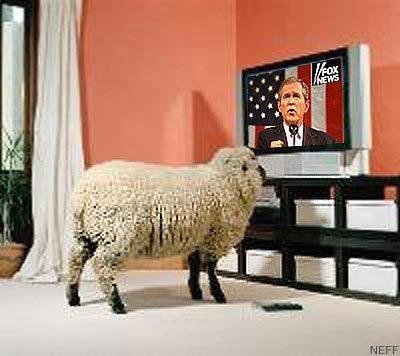
(5) Why do we support these wars?
Who can see into the hearts of men? Not I.
My guess (emphasis on guess): Sheep follow their leaders. That what makes them sheep.
When we no longer choose to be sheep, then America will have taken the first step to reform.
.
(6) For More About Chet’s Perspective
- Is 4th generation warfare dead?, 21 December 2012
- “Is 4GW dead?“, 19 April 2013
- Rebuttal: “4GW is Alive and Well“, William S. Lind, 25 May 2013
(7) For More Information
(a) Lessons about America from 1984:
- The oddity of reports about the Iraq War, 13 March 2008 — CRIMESTOP limits our vision
- Tom Engelhard asks “Is America is hooked on War?”, 19 September 2009 — War is Peace describes US foreign policy
- The long-term consequences to America of torturing Bradley Manning, 15 March 2011 — About the goals of our ruling elites
(b) Posts attempting to find reasons for our wars:
- Stratfor’s analysis of US reasons for invading and occupying Iraq, 4 March 2008
- Stratfor again attempts to explain why we invaded Iraq, 24 March 2008
- Why are we fighting in Afghanistan?, 9 April 2008
- Why are we fighting in Pakistan?, 14 May 2009
- An expert explains why we must fight in Afghanistan, 11 June 2009
(c) Posts about Syria:
- The Syrian dominos, Tom Hayden, 25 October 2012
- Some questions as we march to war in Syria, 17 June 2013
- The first question to ask about our war with Syria has nothing to do with Syria, 28 August 2013
- Q&A on the extraordinary aspects of the Syrian War, 4 September 2013
- What could go wrong if we attack Syria?, 5 September 2013
- The debate about Syria reminds us that a cat can laugh at the King, but the King has the power., 9 September 2013
(d) Posts about the Libyan War:
- Libya’s people need uninvited infidel foreigners to save them!, 1 March 2011
- “You just have not seen enough people bleed to death”, 8 March 2011
- About attacking Libya – let’s give this more thought than we did Afghanistan and Iraq, 6 March 2009
- Our geopolitical experts see the world with the innocent eyes of children (that’s a bad thing), 14 March 2011
- A war monger review, looking at the articles advocating a US war with Libya, 22 March 2011
- Who are we helping in Libya? Here are some answers., 27 March 2011
- In America, both Left and Right love the long war, 30 March 2011
- Why the Libyan War is important to us – and to our children, 9 April 2011
- A status report on our intervention in Libya. Historians will find this farce fascinating., 17 April 2011
- A child-like credulity is required to be a US geopolitical expert, 25 April 2011
- Important information about Libya hidden behind the veil of the US news media, 1 September 2011
.

.
.
