

Summary: Are we ready for the future? Not if we don’t learn from the past. This is a follow-up to Techno-utopians keep us ignorant of the past so we cannot see the future, another look at the dreams and evasions they spin to cloud our vision so that we don’t grab a fair share of the gains.
“In the long run we are all dead. Economists set themselves too easy, too useless a task if, in tempestous seasons, they can only tell us that when the storm is long past the ocean is flat again.”
— John Maynard Keynes in A Tract on Monetary Reform (1923)
We are not here to curse the darkness, but to light the candle that can guide us through that darkness to a safe and sane future. … Today our concern must be with that future. For the world is changing. The old era is ending. The old ways will not do.”
— John F. Kennedy’s Acceptance Speech, 15 July 1960

.
Dreams of a Third Industrial Revolution
Although its effects remain uncertain, by now any who look can see that the Third Industrial Revolution has begun. Like the others, it will reshape society. Power and wealth go to those who manage these changes.
We’re at the stage when pundits work to actively hide the obvious implications, to forestall public policy action to mitigate the damage to vulnerable — and prevent the 1% from grabbing all the gains. A tweetstorms tweets by Silicon Valley’s Marc Andreessen (@pmarca) shows how it’s done. He ignores what we’ve learned from the past, shifts the focus from obvious dangers to strawmen, and looks to the smooth waters at the end (ignoring the rapids and falls of the passage ahead).
1/One of the most interesting topics in modern times is the “robots eat all the jobs” thesis; best book on topic: The Second Machine Age: Work, Progress, and Prosperity in a Time of Brilliant Technologies
2/The thesis is that computers can more and more substitute for human labor, thus displacing jobs and creating unemployment.
3/At core, this is Luddism — “lump of labor” fallacy, that there is a fixed amount of work to be done.
4/The counterargument is Milton Friedman: Human wants and needs are infinite; there is always more to do. 200 years of history confirms.
.
5/To avoid the Luddite mistake, must believe “this time is different”, that either (a) there won’t be new wants and needs (vs human nature),
6/It is hard to believe that people will get these capabilities and then come up with… absolutely nothing useful to do with them.
7/And yet that is the subtext to the “this time is different” argument that there won’t be new ideas, fields, industries, businesses, jobs.
8/In arguing this with an economist friend, response was “But most people are like horses; they have only their manual labor to offer.”
9/I don’t believe that, and I don’t want to live in a world in which that’s the case. I think people everywhere have far more potential.
10/Nor should we. This is how we build a better world, improve quality of life, better provide for our kids, solve fundamental problems.
11/Utopian fantasy you say? OK, so then what’s your preferred long-term state? What else should we be shooting for, if not this?
12/So how then to best help individuals who are buffeted by producer-side technology change and lose jobs they wish they could keep?
13/First, focus on increasing access to education and skill development — which itself will increasingly be delivered via technology.
14/Second, let markets work (voluntary contracts and trade) so that capital and labor can rapidly reallocate to create new fields and jobs.
15/Third, a vigorous social safety net so that people are not stranded and unable to provide for their families.
16/The loop closes as rapid technological productivity improvement and resulting economic growth make it easy to pay for safety net.
He provides a more complete analysis in “This is Probably a Good Time to Say That I Don’t Believe Robots Will Eat All the Jobs“, 13 June 2014.
While fun to fantasize about the future, we have had two industrial revolutions — which provide a reasonable basis on which to make forecasts.

Perhaps the major error of Andreessen’s analysis: overlooking the timing of the pain and gains. We’ve gone through this process before; there is no excuse for starting a new cycle with such ignorance.
Industrial revolutions bring fantastic net benefits to society, but they come to the majority of the population only after decades — or generations. But the costs in lost jobs arrive faster. Lifetimes of experience rendered worthless; lost incomes, and bankruptcies.
Fortunes are made more quickly, with the 1% collecting most of the gains.
These unequal outcomes do not result from the workings of nature, but raw hard politics. The gains go to the powerful, the losses to the proles.
So far we look to repeat the mistakes of earlier cycles, which created so much economic and political instability. Today we give aid to those hurt by automation in pennies, grudgingly given. Even more important, with longer and wider effects, spending cuts decrease social mobility when it’s most needed. For example, everybody genuflects before the need for college degrees, and even more before advanced degrees. Back in the real world State support for public college systems is being slashed (see here, and a specific example here).
It need not be like this. People of the past did not understand the social and economic processes at work. With their experience, we do not have their excuses. This time we can see through the propaganda, and prepare for the future — so we can harvest its benefits without so much pain.
Advice from Eleanor Roosevelt
Rather than rich Pied Pipers, we should listen to sages from our past. Such as Eleanor Roosevelt. Here are most frequently cited words about the future, horrifically guidelines for making public policy:
“The future belongs to those who believe in the beauty of their dreams.”
It is, of course, a fake quote. Eleanor was too sensible to say such dreamy claptrap. Her legacy is sound advice, like this from her last book Tomorrow Is Now (1963):
We face the future fortified with the lessons we have learned from the past. It is today that we must create the world of the future. Spinoza, pointed out that we ourselves can make experience valuable when, by imagination and reason, we turn it into foresight.
… There never has been security. No man has ever known what he would meet around the next corner; if life were predictable it would cease to be life, and be without flavor.
… We must know what we think and speak out, even at the risk of unpopularity. In the final analysis, a democratic government represents the sum total of the courage and the integrity of its individuals. It cannot be better than they are. … In the long run there is no more exhilarating experience than to determine one’s position, state it bravely and then act boldly.
… What we must learn to do is to create unbreakable bonds between the sciences and the humanities. We cannot procrastinate. The world of the future is in our making.
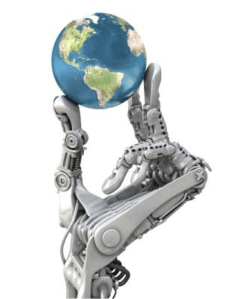
For More Information about the 3rd Industrial Revolution
These posts link to a wealth of information and speculation, helping you to prepare for what is to come.
(a) This post is a follow-up to Techno-utopians keep us ignorant of the past so we cannot see the future, 23 June 2014.
(b) See all posts…
- About the Third Industrial Revolution — now in progress
- About inequality & social mobility: once our strengths, now weaknesses
(c) Corporations build the future
- The new American economy: concentrating business power to suit an unequal society, 27 April 2012
- For Thanksgiving, Walmart shows us the New America, 19 November 2013
- Nike swooshs us into a future of fewer jobs, low pay, 10 March 2014
.

.
.
