

Summary: Police violence is a hot issue in 2015, as NSA surveillance was in 2013. Activists probably will make the same two mistakes now as they did then. First, they’ll build an inadequate political coalition (many whites fear blacks more than the police). Second, they’ll fail to understand the roots of the causes of the problem, making effective treatment difficult or impossible. Here we look at the latter problem. {1st of 2 posts today.}

The pressure grows for reforms to the US law enforcement apparatus as the number of police brutality reports grow. By now it’s well documented, as in this detailed report by the ACLU: “War Comes Home – The Excessive Militarization of American Policing“. Of course resistance from the police has arisen along with opposition from the Right (see this and this story).
Yet the debate includes little discussion about the nature of the problem, which remains on the simplest level. The violence results from “bad apples” among police, plus “insufficient training” and “racism.” There are excuses also, such as “the police shooter was nervous because so many criminals have guns” and “the police shooter feared for his life.”
These are partial truths, at best, on which we’ll build controversial solutions with high odds of failure. Accurate diagnosis should precede treatment if we’re to have good odds of success. Agitating for change is nice, but not enough. Let’s review some important factors at work here.
Consider the context of police violence
Perhaps nothing has changed and we’re just learning about police violence that has happened for decades or even generations. Perhaps journalists have just begun reporting these events. Perhaps the number of cell phone cameras has reached a critical level. Or perhaps police violence has increased, caught by the profusion of cameras — generating a noise level that journalists can’t ignore.
Supporting the latter theory is the big picture. So many other things are changing in America. My guess is that police violence is increasing (not necessarily to historically record highs), and this results from deep changes in American society. We only see the signs it leaves, like the passage of the gophers in my backyard.
(1) America’s police are rapidly militarizing their weapons and tactics.
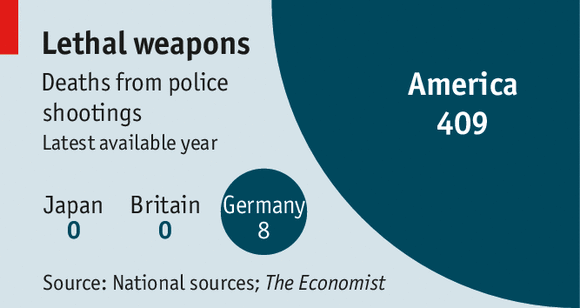
(2) America’s police shoot a lot more people per capita than police in other nations. Quite a few die in situations where the police were not at risk: the victim had no gun, or was even unarmed — often with many police present. An extreme example took place on 22 November 2014 when two police drove their car through an empty park right up to Tamir Rice. A patrolman jumped out; he immediately shot and killed 12-year old Tamir Rice, who was holding an airsoft-type gun. Details here.
(3) We have more armed Federal agents and more Federal SWAT teams, mirroring the increase in the number of SWAT teams during the past few decades at local and state levels.
(4) The power of the police and security services is rapidly growing, driven by decreased judicial restraint, new laws (e.g., Patriot Act), and a massive increase in the intelligence services.
(5) We don’t know how many people the police shoot each year or how many they beat up, let alone how these numbers have changed over time. D. Brian Burghart, editor of the Reno News & Review, runs a crowdsourced national database of people killed by police. His conclusions so far:
You know who dies in the most population-dense areas? Black men. You know who dies in the least population dense areas? Mentally ill men. It’s not to say there aren’t dangerous and desperate criminals killed across the line. But African-Americans and the mentally ill people make up a huge percentage of people killed by police.
What does this add up to? We’re seeing a powerful element of the New America that is rising on the ruins of the America-that-once-was. As the State’s first-line agency using force to maintain order, it’s among the most vital institutions. We need to understand what’s happening with the police and resist the glib analysis and facile solutions so that we can reduce this violence — and stop the evolution of which the violence is just a symptom.
The latest episode of “to protect and serve”
This is a poignant story. Look at this video where a US Marshall charges woman, snatches and smashes her phone. Imagine how she felt as this large man –with his sunglasses, rifle and body armor, lunged towards her. Who was he protecting?

For More Information
For more about this see Radley Balko’s Rise of the Warrior Cop: The Militarization of America’s Police Forces


See these posts about police brutality, especially these:
- How to Fund an American Police State (aka Weaponizing the Body Politic.
- Murder by police. If these incidents do not anger us, then what will?
- Why America has militarized its police and crushes protests.
- Shootings by police show their evolution into “security services”. It’s bad news for the Republic.
- News about police, crime & social decay in America.
- More evidence that we’re losing America. It’s not too late to act.
- News good & bad about the fantastic growth of America’s security services.
