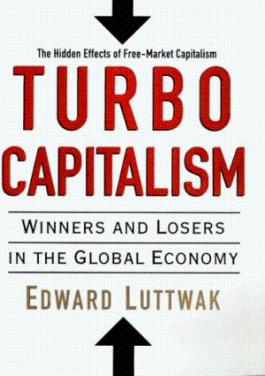
Summary: This morning’s post warning about the resurgence of racism — open, unabashed — was a bust, traffic-wise (we prefer not to know). Let’s look at something different, such as this prescient warning by historian Edward Luttwak. Written in 1994; reads like written today. Articles like this can entertain, but provide more value if acted upon. Elections are won by those who act; voting is not enough.


Why Fascism is the Wave of the Future
Excerpt from an essay by Edward Luttwak
London Review of Books, April 1994
That capitalism …is the ultimate engine of economic growth is an old-hat truth now disputed only by a few cryogenically-preserved Gosplan enthusiasts and a fair number of poorly-paid Anglo-Saxon academics. That the capitalist engine achieves growth as well as it does because its relentless competition destroys old structures and methods, thus allowing more efficient structures and methods to rise in their place, is the most famous bit of Schumpeteriana, even better-known than the amorous escapades of the former University of Czernowitz professor.
And, finally, that structural change can inflict more disruption on working lives, firms, entire industries and their localities than individuals can absorb, or the connective tissue of friendships, families, clans, elective groupings, neighbourhoods, villages, towns, cities or even nations can withstand, is another old-hat truth more easily recognised than Gemeinschaft and Gesellschaft can be spelled.
…In this situation, what does the moderate Right – mainstream US Republicans, British Tories and all their counterparts elsewhere – have to offer? Only more free trade and globalisation, more deregulation and structural change, thus more dislocation of lives and social relations. It is only mildly amusing that nowadays the standard Republican/Tory after-dinner speech is a two-part affair, in which part one celebrates the virtues of unimpeded competition and dynamic structural change, while part two mourns the decline of the family and community ‘values’ that were eroded precisely by the forces commended in part one. Thus at the present time the core of Republican/Tory beliefs is a perfect non-sequitur.


What does the moderate Left have to offer? Only more redistribution, more public assistance, and particularist concern for particular groups that can claim victim status, from the sublime peak of elderly, handicapped, black lesbians down to the merely poor.
Thus neither the moderate Right nor the moderate Left even recognises, let alone offers any solution for, the central problem of our days: the completely unprecedented personal economic insecurity of working people, from industrial workers and white-collar clerks to medium-high managers.
None of them are poor and they therefore cannot benefit from the more generous welfare payments that the moderate Left is inclined to offer. Nor are they particularly envious of the rich, and they therefore tend to be uninterested in redistribution. Few of them are actually unemployed, and they are therefore unmoved by Republican/Tory promises of more growth and more jobs through the magic of the unfettered market: what they want is security in the jobs they already have – i.e. precisely what unfettered markets threaten.
A vast political space is thus left vacant by the Republican/Tory non-sequitur, on the one hand, and moderate Left particularism and assistentialism, on the other. That was the space briefly occupied in the USA by the 1992 election-year caprices of Ross Perot …And that is the space that remains wide open for a product-improved Fascist party, dedicated to the enhancement of the personal economic security of the broad masses of (mainly) white-collar working people.
Such a party could even be as free of racism as Mussolini’s original was until the alliance with Hitler, because its real stock in trade would be corporativist restraints on corporate Darwinism, and delaying if not blocking barriers against globalisation. It is not necessary to know how to spell Gemeinschaft and Gesellschaft to recognise the Fascist predisposition engendered by today’s turbocharged capitalism.
——————– Read the full essay ——————–
Afterword
Luttwak aptly describes the economic reasons people turn to fascism. But there are other reasons. Capitalism — the social disruption it creates — shatter the communities that give social security and meaning to many people, leading to feelings of alienation and isolation. Fascism, like many religious and ideological mass movements, offers an alternative to what’s been lost and a connection to one’s (often mythical) past.
We cannot fight what we do not understand, or counter movements when we refuse to see the social forces powering them.


About the author
Edward Luttwak is a historian and political scientists, now with the Center for Strategic and International Studies. See his bio there and his Wikipedia entry for more information.
He has written several books, including The Endangered American Dream


For More Information
For data about the rise of fascist tendencies see these graphs in today’s WaPo. The framing is typical political science leftist claptrap; the author does not even attempt to show that Trump is an authoritarian — she just assumes it. But the danger is real.
For more about fascism see “Ur-Fascism” by Umberto Eco at The New York Review of Books (1995).
If you liked this post, like us on Facebook and follow us on Twitter.See all posts about fascism, about the rise of populism in Campaign 2016, and especially these
- What will replace the Constitution in Americans’ hearts? Let’s check for Fascism.
- Gallup warns us to prepare for fascism!
- Americans trust the military most. 29% are ready for a coup. Ready for fascism?
- Good news: we begin to see that we are sliding towards fascism.