

Summary: We cannot find the few dollars needed to study serious threats like Climate Change and Peak Oil. But the military effortlessly obtains funds to study star travel. Our nation’s physical infrastructure rots. But the military effortlessly obtains the funds for beyond-cutting edge projects like the WaveRider X-51A. Is this how empires die? Can we do better, like develop new forms of energy (which we’ll desperately need).
Contents
How should we invest in our future, to improve our prosperity and national security — so that our descendents will think of us in admiration, instead of as oddly dressed fools? Let’s look at compare the WaveRider to one of the many possible areas for R&D projects: new forms of energy. What might happen if we funded these at far higher levels? We might get ample clean energy for the 21st century. (update: or not. These are all lab-stage projects, and as such we cannot count on them).

- WaveRider x-51A
- Focus Fusion
- National Spherical Torus Experiment
- The Polywell
- Tri Alpha Energy
- Other fusion projects
- For more information
- See the Future! Videos and graphics.
(1) WaveRider x-51A hypersonic cruise missile
.
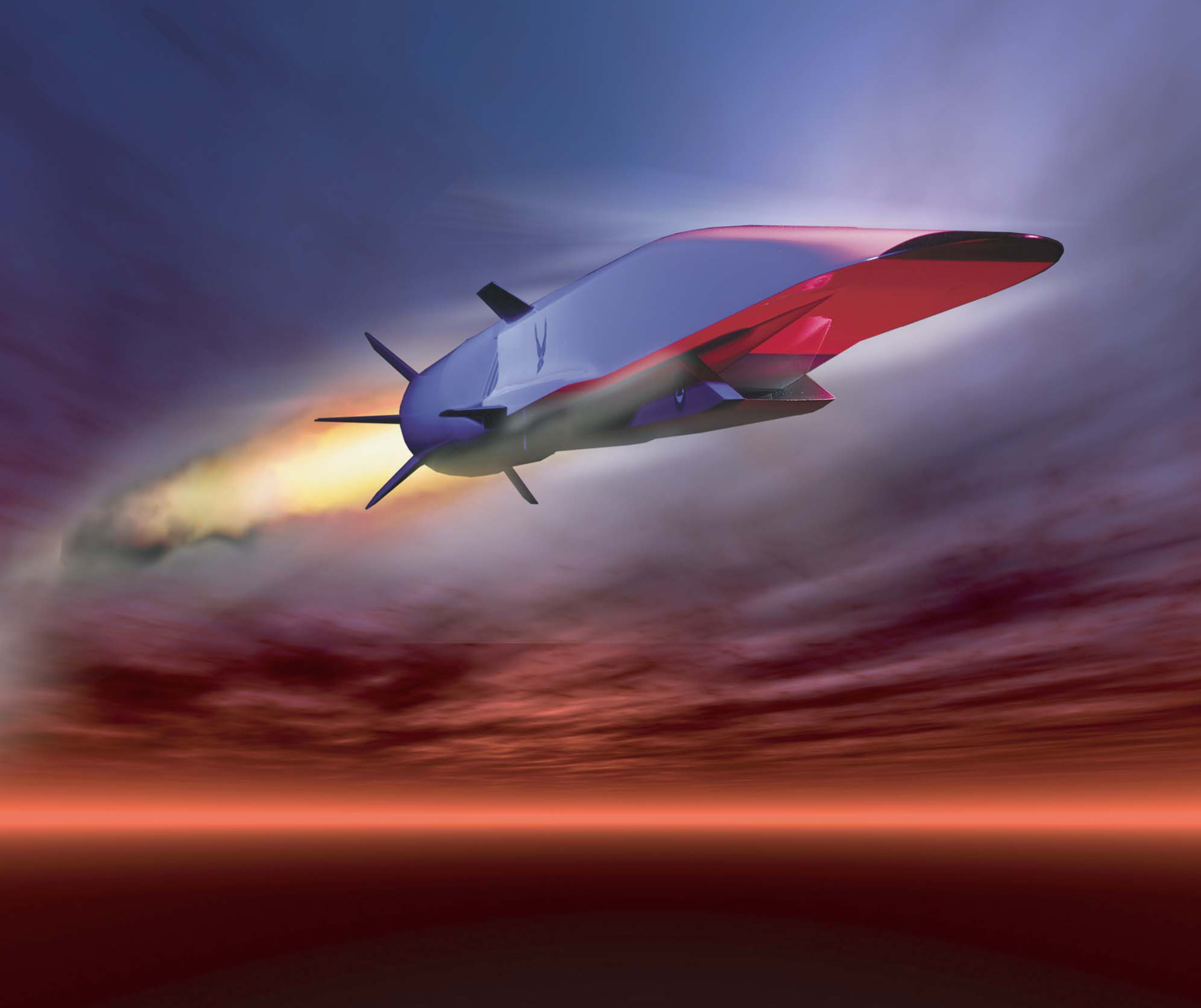
Speed: Mach 5 and beyond)
Coolness factor: warp 8.
Factor for smart use of scarce funds: bimbo 8.
Purpose: Nothing worth $300 million. But we’ll be ready when Mars attacks!
Results so far: 4 built (non-recoverable single-use). Three tests, one partial success & two failures.
Big lie: it’s a step towards hypersonic passenger travel!
Cost: Secret. Estimates of funds spent so far are $250-300 million, plus more on the previous projects.
For a more information see: GlobalSecurity and Wikipedia.

(2) Focus Fusion
From the website of Lawrenceville Plasma Physics, Inc.:
… is a high-tech research and development corporation specializing in applications of plasma physics, including fusion power and intense X-ray sources.
Our lead project is the development of an inherently clean fusion energy generator using a device called the dense plasma focus (DPF) and hydrogen-boron fuel, an approach we call “Focus Fusion.”
This work was initially funded by NASA’s Jet Propulsion Laboratory and is now backed by over forty private investors including the Abell Foundation of Baltimore. LPP’s patented technology and peer-reviewed science will guide the design of a compact, environmentally safe and virtually unlimited source of energy that would be at least ten times cheaper than any existing sources.
Our research team has already achieved major experimental milestones, including the achievement of plasma confinement at energies equivalent to two billion degrees, high enough to fuse hydrogen and boron. We intend to win the race for this ultimate energy prize by demonstrating the scientific feasibility of Focus Fusion at our laboratory in Middlesex, NJ. Non-exclusive licenses to government agencies and manufacturing partners will aim to ensure rapid adoption of Focus Fusion generators as the primary source of electrical power worldwide.
For more photos, videos, and links see this page at ALT FIN ENERGY, and the Wikipedia entry for Dense Plasma Focus.

(3) National Spherical Torus Experiment
Cost: $100 million from 2009-2015 (from slide 53 of the 2012 budget ppt)
The National Spherical Torus Experiment (NSTX) is an innovative magnetic fusion device that was constructed by the Princeton Plasma Physics Laboratory (PPPL) in collaboration with the Oak Ridge National Laboratory, Columbia University, and the University of Washington at Seattle.
First plasma was obtained on NSTX on Friday, February 12, 1999 at 6:06 p.m. NSTX is being used to study the physics principles of spherically shaped plasmas — hot ionized gases in which nuclear fusion will occur under the appropriate conditions of temperature, density, and confinement in a magnetic field. Fusion is the energy source of the Sun and all the stars. Scientists believe it can provide an inexhaustible, safe, and environmentally attractive source of energy on earth.
Magnetic fusion experiments use plasmas comprised of one or more of the isotopes of hydrogen. For example, in 1994, PPPL’s Tokamak Fusion Test Reactor (TFTR) produced a world-record 10.7 million watts of fusion power from a plasma comprised of equal parts of deuterium and tritium, the fuel mix likely to be used in commercial fusion power reactors. NSTX is a “proof of principle” experiment and therefore employs deuterium plasmas only. If successful it will be followed by similar devices, eventually including a demonstration power reactor, burning deuterium-tritium fuel.
NSTX produces a plasma that is shaped like a sphere with a hole through its center, different from the “donut” shaped plasmas of conventional tokamaks. This innovative plasma configuration may have several advantages, a major one being the ability to confine a higher plasma pressure for a given magnetic field strength. Since the amount of fusion power produced is proportional to the square of the plasma pressure, the use of spherically shaped plasmas could allow the development of smaller, more economical fusion reactors. NSTX’s attractiveness may be further enhanced by its ability to produce a high “bootstrap” electric current. This self-driven internal plasma current would significantly reduce the power requirements of externally driven plasma currents required to heat and confine the plasma.
For more information see the NSTX Project Home Page and Building Components of the NSTX.
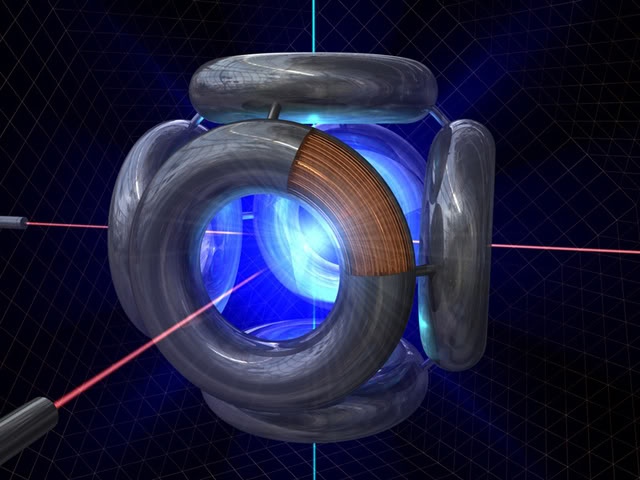
(4) The Polywell
Great potential. Lots of misinformation circulating about it.
The Polywell’s developers founded EMC2 Fusion Development a charitable research and development Corporation, to develop frontier energy technologies with an emphasis on fusion. From their website:
Successfully Completed in 2008 – Fusion R&D Phase 1: Validate and extend WB-6 results with WB-7 Device; test confinement behavior with detailed diagnostics. Required 1.5 years (2008-2010) and $1.8 million.
In process – Fusion R&D Phase 2: Design, build and test larger scale WB-8 Polywell Device. Estimated to require 2 years and $7 million (provided by the US Navy. Results to date are confidential. Here’s what little we know, from the reports on the Recovery.gov website:
- “As of 2Q/2011, the WB-8 device has demonstrated excellent plasma confinement properties. EMC2 is conducting high power pulsed experiments on WB-8 to test the Wiffle-Ball plasma scaling law on plasma energy and confinement.”
- “As of 3Q/2011, the WB-8 device has generated over 500 high power plasma shots. EMC2 is conducting tests on Wiffle-Ball plasma scaling law on plasma heating and confinement.”
- “During 4Q of 2011, EMC2 has modified the electron injectors to increase the plasma heating. The higher plasma density in WB-8 prompted the need for higher heating power. We plan to operate WB-8 in high beta regime with the modified electron injectors during 1Q of 2012.”
Next – Fusion R&D Phase 3: Design, build and test full scale 100 MW Fusion System. Estimated to require 4 years and $200 million. Now under design.

(5) Tri Alpha Energy
We know little of Tri Alpha. No website. Only dribs of information, mostly from rumors and a few papers at conferences.
- “Startup Chases Nuclear Fusion“, Next Energy News, 22 June 2007
- “Tri Alpha Energy Gets $50 million“, So Calif Tech News, 26 July 2010
- The most detailed I’ve seen: “Tri Alpha Energy – Secretive Clean Fusion Power“, Alternative Energy Now, January 2012
If these stories are correct, this is an amazing project: early stage R&D conducted on a large scale with all private capital. I cannot think of any parallel.
(6) Other fusion projects (with Wikipedia links)

- International Thermonuclear Experimental Reactor (ITER)
- The US National Ignition Facility
- DEMOnstration Power Plant (DEMO)
- High Power laser Energy Research facility (HiPER)
- International Fusion Materials Irradiation Facility (IFMIF)
- Joint European Torus (JET)
- Laboratory for Laser Energetics
- Laser Mégajoule (LMJ)
- Wendelstein 7-X
(7) For more information
To see all posts go to the FM Reference Page Peak Oil and Energy.
About fusion:
- Fusion energy, too risky a bet for America (we prefer to rely on war) , 4 May 2008
- A long-shot project for fusion power: the Polywell, 30 September 2008
About new energy sources:
- An urban legend to comfort America: crash programs will solve Peak Oil, 5 September 2008
- An urban legend to comfort America: alternative energy will save us, 16 September 2008
- Another example showing how energy research is just inspired guessing, since America prefers being blind, 23 September 2008
- Could a new “Manhattan Project” produce radically new energy sources?, 29 June 2010
- Eventually we’ll have unlimited cheap clean energy. But that will not help us or our kids., 15 February 2011
(8) See the future!
(a) See the X-51A WaveRider in action
.

.
(b) But even better things await us in the future
Your grandchildren might see this, or something equally awesome, during a field trip to the local power plant. It’s a conceptual graphic of a Helion Energy generator by Torulf2, posted at Talk Polywell on 27 May 2009.
.

.
