

Summary: America’s largest investment program is its military. Hundreds of bases around the world. Fighting dozens of small wars. Our advanced aerospace program is largely military. Much of America’s R&D is done by DARPA and other defense agencies. Meanwhile Congress quibbles about million-dollar programs while waving through multi-billion-dollar defense programs.
Today Winslow Wheeler explains how DoD will spend a trillion dollars in the next year. It’s not what you think; it’s not what you’ve been told.

“America’s $1 Trillion National Security Budget“
By Winslow Wheeler
The Straus Military Reform Project
13 March 2014
Reposted with their generous permission
The Pentagon’s current leadership and most on the House and Senate Armed Services Committees in Congress describe President Obama’s 2015 defense budget request as painfully austere, if not dangerously inadequate. The defense trade press is full of statements from generals, admirals and the other politicians from both political parties that there is not nearly enough money available to buy adequate amounts of new hardware, maintain current pay and benefits or provide even low amounts of training and equipment maintenance. As a result, they are looking for ways to relieve the Pentagon from its penury.
Scarcity of money is not their problem. Pentagon costs, taken together with other known national security expenses for 2015, will exceed $1 Trillion. How can that be? The trade press is full of statements about the Pentagon’s $495.6 billion budget and how low that is.
There is much more than $495.6 billion in the budget for the Pentagon, and there are piles of national security spending outside the Pentagon — all of it as elemental for national security as any new aircraft and ships and the morale and well-being of our troops.
The official version
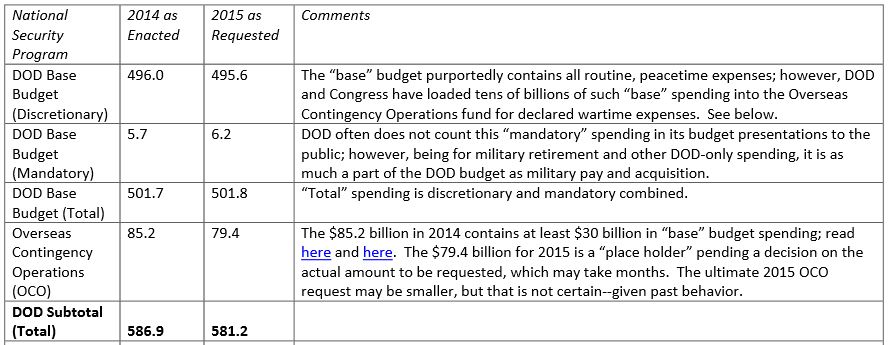
The table below details what a careful observer will find in President Obama’s 2015 budget presentation materials. The amounts for the Pentagon are well above the advertised $495.6 billion, and there are several non-Pentagon accounts that are clearly relevant.
The relevant data for 2014 is also presented for comparison, and the notations in the “Comments” column help explain the data.
Total U.S. National Security Spending 2014-2015
All figures are $billions; Then-Year$
Sources: Table 28-1 from Analytical Perspectives and Homeland Security Appendix in 2015 OMB Budget


Click here for pdf of this chart (easier to read).
Note the various ways the Pentagon augments its own budget well above the $495.6 billion that is frequently cited by the people seeking more money.
- There is the additional “placeholder” amount for the wars in Afghanistan and elsewhere ($79.4 billion), which may or may not turn out to be smaller once the formal request for this spending is compiled and Congress is finished fiddling with it: adding huge amounts of non-war (or “base”) spending to this account by both DOD and Congress is routine.
- There is also the $6.2 billion in “mandatory” (or entitlement) spending the Pentagon’s complete budget must include for military retirement and other DOD-only programs.
- There is the Pentagon’s $26 billion dollar portion of the “Opportunity, Growth and Security Initiative” (a slush fund if ever there were one) that OMB and Secretary of Defense Hagel have dreamed up — to the applause of the Joint Chiefs of Staff.
- While some in the press have caught most of the above additions, they virtually never spot the additional money the Treasury pays out for additional military retirement ($37.8 billion in 2015) and DOD healthcare (just $100 million in 2015 but more in other years).
In all, the Pentagon’s budget for all of its own expenses in 2015 is not $495.6 billion, it is $645.1 billion, or $149.5 billion (30%) more. (Don’t add the four score billions of dollars for intelligence and snooping; the budgets for CIA, NSA and all the rest are embedded in the DOD budget.)
Other defense spending, and the grand total
If one were to add the nuclear weapons’ costs borne by the Department of Energy, the amount would be $664.5 billion, or 34% more.
Consider also the substantial costs that are properly outside of the Pentagon’s budget but are central to US national security:
- $52.1 billion in non-DOD spending in the Department of Homeland Security,
- $161.2 billion for the human consequences of past and ongoing wars in the Department of Veterans Affairs, and
- $39 billion for the activities of the Department of State and related agencies-for international security and the exercise of US power abroad.
With the addition of an equitable share of the interest on the national debt that is attributable to this spending, it all adds up to $1.0095 trillion. It is that amount, not $495.6 billion, that US taxpayers are being asked to pay out in 2015 for “defense,” defined generically. However, you will not find that number in the talking points of the Joint Chiefs of Staff, Secretary Hagel, or most Republicans and Democrats on the House and Senate Armed Services Committees. They are arguing that times are tough and if still more money can be found, it should go to these accounts.
Historical Comparisons
There is another perspective to measure defense spending in 2015. We can compare just the amounts formally requested for the Pentagon (the “base” budget plus the “placeholder” amount for Overseas Contingency Operations) to what has been spent historically. By converting annual Pentagon spending to “constant” (inflation adjusted) dollars adjusted to their 2015 value, and by using the economy-wide GDP measure of inflation for doing so (not the Pentagon’s own hopelessly self-serving measure of inflation), we can compare the 2015 Pentagon budget to its post-World War Two history.
See the figure below from a study by the Center for Strategic and Budgetary Assessments (CSBA) study “Chaos and Uncertainty: The 2014 Defense Budget and Beyond” by Todd Harrison (2013); see Figure 18 on page 25. Spending is in OMB Constant GDP (Chained) 2015 dollars.

This graph tells us that the 2015 level of Pentagon spending would return us to the same overall level as 2005 when Donald Rumsfeld was secretary of defense and the DOD budget was generally considered flush with money and supporting substantial fighting in both the Iraq and Afghanistan wars. Note also that this is a level of spending that matches the peak of the Ronald Reagan years that was thought by its advocates to be a US build up so massive it was intimidating the Soviet Union into collapse. The 2015 level is also an amount that significantly exceeds the peaks of the Korea and Vietnam wars — both of them higher intensity conflicts with hundreds of thousands more US troops deployed than are currently in Afghanistan.
The Defense Machine is well-fed

To repeat, the problem is not scarcity of money. The problem is how it is being spent. We are getting very little defense — training, maintenance, hardware, and troops — for a gigantic amount of money. By virtue of how they characterize $1 trillion dollars as penury, our national security leaders in the Pentagon and Congress are clearly incapable of dealing with the problem.
Our equipment is outrageously expensive and yet too much of it is a step backwards in effectiveness. Since the mid-1990s Congress has bulldozed money into across-the-board pay raises, double pensions for many military retirees, significantly increased benefits for the survivors of WW2 veterans and much else that has much more to do with placating constituencies than addressing 21st century security problems.
In addition, the Pentagon’s civilian and military leadership has bloated itself to historically unprecedented levels of overhead.
Worse yet, none of them have even bothered to fundamentally understand the dimension of the problems because, under their tutelage, the Pentagon remains unaudited and un-auditable, which will remain the case even after it meets its decades overdue, and embarrassingly modest, financial management goals-which by the way, it will do no time soon.
One more time: the problem is not scarcity of money.
———————————————————————
About the author
Winslow T. Wheeler is Director of the Straus Military Reform Project at the Project On Government Oversight (POGO) in Washington, D.C.
From 1971 to 2002, Wheeler worked on national security issues for members of the U.S. Senate and for the US Government Accountability Office (GAO). He was the first, and according to Senate records the last, Senate staffer to work simultaneously on the personal staffs of a Republican and a Democrat (Pryor and Kassebaum).
In the Senate staff, Wheeler was involved in legislation concerning the War Powers Act, Pentagon reform, foreign policy, and oversight of the defense budget/programs. At GAO he directed comprehensive studies on the 1991 Gulf War air campaign, the US strategic nuclear triad, and weapons testing. Each of these studies found prevailing conventional wisdom about weapons to be badly misinformed.
In 2002 when he worked on the Republican staff of the Senate Budget Committee, Wheeler authored an essay, under the pseudonym “Spartacus,” addressing Congress’ reaction to the September 11, 2001 terrorist attacks (“Mr. Smith Is Dead: No One Stands in the Way as Congress Lards Post-September 11 Defense Bills with Pork“). When senators criticized in the essay attempted to have Wheeler fired, he resigned his position.
He has authored two books: The Wastrels of Defense (2004) about Congress and national security, and Military Reform (2007). He was the Editor of America’s Defense Meltdown (2009). He also edited of two anthologies, The Pentagon Labyrinth: 10 Short Essays to Help You Through It (2011) and America’s Defense Meltdown: Military Reform for President Obama and the New Congress (2009).
He appears in interviews on national TV and radio and has written articles and commentaries for national, local, and professional publications. These venues include “60 Minutes,” C-SPAN’s “Book Notes” and “Q & A,” National Public Radio, the PBS News Hour, the Washington Post, Politico, Mother Jones, Barron’s, Defense News, and Armed Forces Journal.
Click here for more information about the Straus Military Reform Project.
A few articles by Winslow Wheeler at POGO:
- The Myth of American Military Superiority, 13 October 2012
- Budget and Hardware Myths, Part II, 1 October 2012
- Budget and Hardware Myths, Part I, 1 October 2012
- Sequester: Not All It’s Cracked Up To Be, 16 August 2012
- Common Defense Quarterly Article on Drones, 15 June 2012
- Think-Tanked: Old Wine in Dark Bottles, 13 June 2012
- A Peek at Pentagon Pork: A Taxpayers’ Guide, 29 May 2012
- The Jet That Ate The Pentagon, 2 May 2012
For More Information
Other posts by Winslow Wheeler:
- Another step in America’s Defense Meltdown, 30 July 2009
- The ultimate 21st Century cage match: Titanic Government vs. the National Security Iceberg, 20 December 2012
Posts about military spending:
- The foundation of America’s empire: our chain of bases around the world, 8 September 2008
- The economic Death Spiral of the Pentagon, 7 February 2009
- Do we overpay the members of our armed services?, 25 June 2010
- About the rising pressure to cut the US military budget, July 2010
- Dragging American Military Culture into the 21st Century, 13 August 2010
- We could reduce government bureaucracy, but much of it is military/intel – and untouchable, 31 August 2010
- Important new articles about reforming our military, a key to balancing the Federal budget, 29 April 2011
- Reconfiguring the US military for life after The Long War, 27 September 2011 — By Doug Macgregor
- Profits in the New America: lobbyists drill for public money, 13 March 2013

