

Summary: Eminent climate scientist Judith Curry gives a brief assessment of the threat of climate change, starting from first principles — such as the definition of “risk”. It is a timely reminder, as the debate about the public policy response to climate change moves into hysteria.
“US politics could be focused on preventing climate change from destroying all life on Earth. Instead, it’s focused on Vlad Putin & Nordstrom.”
— David Sirota on Twitter (74 thousand followers). He is a radio host based in Denver, nationally syndicated columnist, and Democratic political spokesperson. He says this often, ignoring those pointing out that the IPCC’s Working Group I’s reports say nothing remotely like that. See his Wikipedia entry.

The ‘threat’ of climate change
By Judith Curry,
Posted at Climate Etc, 29 January 2017.
Posted under a Creative Commons License
A major disconnect in the discourse surrounding climate change is interpretation of the ‘threat’ of climate change.
Last week I attended the annual meeting of the American Meteorological Society in Seattle. It was a very good meeting …One of the best things about such conferences is the opportunity for extended face to face discussions with other scientists. I had one such discussion that triggered the theme for this post. This scientist (who will remain unnamed) does not disagree with me about climate change science in any significant way, although he has more confidence in climate models than I do. In particular, he has publicly discussed the uncertainty issue.
He doesn’t take the ‘heat’ that I do largely because, in spite of these substantial uncertainties, he makes statements about the ‘serious threat’ of climate change, substantial risk of dangerous or even calamitous impacts, reducing this risk requires a reduction of carbon emissions.
We both agree that there is the ‘possibility’ of extreme impacts if the warming is on the high end of the model projections. We agree that we can’t quantify the probability of such impacts; it is best to regard them as ‘possibilities.’
So, what is the differences in reasoning that lead us to different conclusions regarding policy responses?

Definitions of ‘threat’ and ‘risk’.
Some definitions of ‘threat’…
- indication of an approaching or imminent menace,
- an impending danger that has the potential to cause serious harm,
- a person or thing likely to cause damage or danger, and
- the possibility of trouble, danger, or ruin.
- The related terms “threat” and “hazard” are often used to mean something that could cause harm.
Two of the definitions imply something that has a high probability of occurring: ‘approaching’, ‘imminent’, ‘impending’. A third definition includes the term ‘likely’, which (at least in IPCC parlance) implies a probability > 66%. The last definition uses the word ‘possibility’.
The ‘possibility’ definition seems to be used for military threats and for threats to computer security. For issues related to extreme weather events, food and water shortages, the ‘imminent’ or ‘impending’ definitions are arguably the more common parlance.
As per the Wikipedia entry for risk, ‘risk’ has connotations of ‘probability’ and ‘quantifiable damage’. The words that are used — threat and risk — provide connotations of impending damage and that this is quantifiable and avoidable.
“A probability or threat of damage, injury, liability, loss, or any other negative occurrence that is caused by external or internal vulnerabilities, and that may be avoided through preemptive action.”
Editor’s note: the modern concept of risk goes back to F. H. Knight’s 1921 book, Risk Uncertainty and Profit


“The practical difference between the two categories, risk and uncertainty, is that in the former the distribution of the outcome in a group of instances is known (either through calculation a priori or from statistics of past experience), while in the case of uncertainty that is not true, the reason being in general that it is impossible to form a group of instances, because the situation dealt with is in a high degree unique.”
I think that use of these words mislead the public debate on climate change — any damages from human caused climate change are not imminent, we cannot quantify the risk owing to deep uncertainties, and any conceivable policy for reducing CO2 emissions will have little impact on the hypothesized damages in the 21st century.
‘Threats’ or ‘reasons for concern’?
I do not question that the possibility of adverse impacts from human caused climate change should be under consideration. However, the human caused impacts of climate change have been overhyped from the beginning — the 1992 UNFCCC treaty on avoiding dangerous human interference on the climate. This implied warming was dangerous before any work had actually been done on this.
Some much needed clarification is presented in a recent article published in Nature: “IPCC reasons for concern regarding climate change risks“, 4 January 2017. This article provides a good overview of the current IPCC framework for considering dangerous impacts. A summary of the main concerns.
The reasons for concern (RFCs) reported in AR5 are…
- Risks to unique and threatened systems (indicated by RFC1).
- Risks associated with extreme weather events (RFC2).
- Risks associated with the distribution of impacts (RFC3).
- Risks associated with global aggregate impacts (RFC4).
- Risks associated with large-scale singular events (RFC5).
“…Eight overarching key risks representative of the range of key risks identified by WG II authors as of highest concern to their chapters (ref. 6, section 19.6.2.1, based on Table 19-4). These risks inform judgments regarding the indicated RFCs.
- Risk of death, injury, ill-health, or disrupted livelihoods in low-lying coastal zones and small island developing states and other small islands due to storm surges, coastal flooding, and sea-level rise.
- Risk of severe ill-health and disrupted livelihoods for large urban populations due to inland flooding in some regions.
- Systemic risks due to extreme weather events leading to breakdown of infrastructure networks and critical services such as electricity, water supply, and health and emergency services.
- Risk of mortality and morbidity during periods of extreme heat, particularly for vulnerable urban populations and those working outdoors in urban or rural areas.
- Risk of food insecurity and the breakdown of food systems linked to warming, drought, flooding, and precipitation variability and extremes, particularly for poorer populations in urban and rural settings.
- Risk of loss of rural livelihoods and income due to insufficient access to drinking and irrigation water and reduced agricultural productivity, particularly for farmers and pastoralists with minimal capital in semi-arid regions.
- Risk of loss of marine and coastal ecosystems, biodiversity, and the ecosystem goods, functions, and services they provide for coastal livelihoods, especially for fishing communities in the tropics and the Arctic.
- Risk of loss of terrestrial and inland water ecosystems, biodiversity, and the ecosystem goods, functions, and services they provide for livelihoods.”
I think that qualitatively, these are the appropriate risks to consider. Where I don’t find this analysis particularly convincing is their links of ‘undetectable’, ‘moderate’, ‘high’, ‘very high’ to specific levels of temperature increase.
The confounding societal effects on all of these risks are overwhelming, IMO, and very likely to be of greater concern than actual temperature increase. Apart from (7) and (8) related to ecosystems, these risks relate to vulnerability of social systems. These vulnerabilities have put societies at risk for extreme weather events throughout recorded history — adding a ‘delta’ to risk from climate change does not change the fundamental underlying societal vulnerabilities to extreme weather events.
The key point IMO is one that I made in a previous post Is climate change a ‘ruin’ problem? The short answer is ‘no’ — even under the most alarming projections, human caused climate change is not an existential threat on the timescale of the 21st century.
JC’s reflections.
So what are the words that we should use to talk about the potential harm from human caused climate change? I think that the following phrases are appropriate…
- potential harm,
- reasons for concern, and
- possible catastrophic impacts.
I think that ‘threat’ is overly alarmist, since it implies imminent harm. ‘Risk’ is not overly alarmist, but it does imply that the harm is quantifiable and mitigable — which I have argued that it is not.
How do we deal with potential harm and possible catastrophic impacts? This puts us in the domain of decision making under deep uncertainty — a topic I have written about many times at CE.
I have been planning a full post on this, but I am way behind, so I will point to this here: Society for Decision Making Under Deep Uncertainty — deep uncertainty.org — under the leadership of Robert Lempert (who has been featured in several previous CE posts). This society and its website is a gold mine of information that can be used for thinking about how we should respond to the wicked climate change problem.
——————————- End post. ——————————-

About Judith Curry
Judith Curry recently retired as a Professor of the School of Earth and Atmospheric Sciences at the Georgia Institute of Technology. She is now President and co-owner of Climate Forecast Applications Network (CFAN). Prior to joining the faculty at Georgia Tech, she served on the faculty of the University of Colorado, Penn State University and Purdue University.
She serves on the NASA Advisory Council Earth Science Subcommittee and the DOE Biological and Environmental Science Advisory Committee. She recently served on the National Academies Climate Research Committee and the Space Studies Board, and the NOAA Climate Working Group.
She is a Fellow of the American Meteorological Society, the American Association for the Advancement of Science, and the American Geophysical Union. Her views on climate change are best summarized by her Congressional Testimony.
- Rational Discussion of Climate Change: the Science, the Evidence, the Response, Nov 2010.
- Policy Relevant Climate Issues in Context, April 2013.

For More Information
If you liked this post, like us on Facebook and follow us on Twitter. For more information about this vital issue see the keys to understanding climate change, all posts about shockwaves (high impact, low probability scenarios), and especially these …
- We are so vulnerable to so many things. What is the best response?
- Preparing for the future: should we be precautionary or proactionary?
- The first step to protecting the world from its many dangers.
- Nassim Nicholas Taleb looks at the risks threatening humanity.
For a better understanding of climate change…

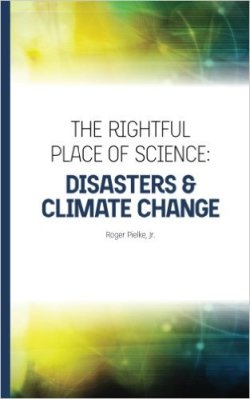

To learn more about the state of climate change see The Rightful Place of Science: Disasters and Climate Change

“In recent years the media, politicians, and activists have popularized the notion that climate change has made disasters worse. But what does the science actually say? Roger Pielke, Jr. takes a close look at the work of the Intergovernmental Panel on Climate Change, the underlying scientific research, and the data to give you the latest science on disasters and climate change. What he finds may surprise you and raise questions about the role of science in political debates.”
