Summary: We have so much power, knowledge, and ideology. We lack only perspective on our situation. But that is something we can gain from the past – such as seen here. For the Boomers, the lessons are sad – but perhaps useful for their children.
“Mutato nomine de te fabula narratur.” (The name has been changed but the story is about you.)
— Book I of Horace’s Satires


Fruits of the Boomers’ dreams.

The Boomers are one of the pivotal generations in American history. We inherited America at its high tide. We grew up with the landings on the moon, the Great Society (which ended the South’s successful post-Civil War insurgency), the great alliances that maintained world peace among the major powers, and the massive expansion of higher education to all classes. Both Left and Right had high ideals and a glorious vision of the future. These were epitomized in Robert Heinlein’s 1950’s science fiction novels that we read when young and the Star Trek (the original ones) that we watched as adults. They were a future of growing order, peace, and prosperity.
All of this has collapsed into rubble. Worst of all, our children and grandchildren totally repudiate our values. Marriage is increasingly obsolete. The Left despises our liberal values, with racism and sexism their new lodestars. Meritocracy is evil, allocations by race and sex are the future. Individualism is evil, group identify is everything. Capitalism is evil. Democracy is valid only when it produces the proper outcomes. America is widely seen as illegitimate, belief in our core rights (such as freedom of speech and religion) is weak or broken.
On the right, the ancient evils of racism, sexism, and anti-Semitism are resurgent. Confidence in the wisdom of the people is rare; confidence in guns is growing. They remain loyalists of the old pieties – such as Christianity and the Constitution. I wonder how long that will continue if we encounter difficult times. Works such as William Lind’s Victoria

A sad aspect of the Boomers’ legacy is that so many of our descendants consider us the Worst Generation. The worst is that future historians might agree with them.
“The health of a people comes only from its inner life – from the life of its soul and its spirit.”
— Words on a granite memorial stone in Berlin marking where Walther Rathenau “fell on this spot by the hand of a murderer.”
See our future in the ruins of the past
“{History repeats itself} the first time as tragedy, the second time as farce.”
— By Karl Marx in The Eighteenth Brumaire of Louis Bonaparte .


The excerpts below from Stefan Zweig’s autobiography The World of Yesterday
“In the collapse of all values a kind of madness gained hold particularly in the bourgeois circles which until then had been unshakable in their probity.”
Chapter 1: the world of security.
When I attempt to find a simple formula for the period in which I grew up, prior to the First World War, I hope that I convey its fulness by calling it the Golden Age of Security. Everything in our almost thousand-year-old Austrian monarchy seemed based on permanency, and the State itself was the chief guarantor of this stability. The rights which it granted to its citizens were duly confirmed by parliament, the freely elected representative of the people, and every duty was exactly prescribed. Our currency, the Austrian crown, circulated in bright gold pieces, an assurance of its immutability. …
In this vast empire everything stood firmly and immovably in its appointed place, and at its head was the aged emperor; and were he to die, one knew (or believed) another would come to take his place, and nothing would change in the well-regulated order. No one thought of revolutions or revolts. …One’s house was insured against fire and theft, one’s field against hail and storm, one’s person against accident and sickness. …
Despite the propriety and the modesty of this view of life, there was a grave and dangerous arrogance in this touching confidence that we had barricaded ourselves to the last loophole against any possible invasion of fate. In its liberal idealism, the 19th century was honestly convinced that it was on the straight and unfailing path toward being the best of all worlds. Earlier eras, with their wars, famines, and revolts, were deprecated as times when mankind was still immature and unenlightened. But now it was merely a matter of decades until the last vestige of evil and violence would finally be conquered, and this faith in an uninterrupted and irresistible “progress” truly had the force of a religion for that generation. One began to believe more in this “progress” than in the Bible, and its gospel appeared ultimate because of the daily new wonders of science and technology. In fact, at the end of this peaceful century, a general advance became more marked, more rapid, more varied. …
Progress was also made in social matters; year after year new rights were accorded to the individual, justice was administered more benignly and humanely, and even the problem of problems, the poverty of the great masses, no longer seemed insurmountable. The right to vote was being accorded to wider circles, and with it the possibility of legally protecting their interests. Sociologists and professors competed with one another to create healthier and happier living conditions for the proletariat. Small wonder, then, that this century sunned itself in its own accomplishments and looked upon each completed decade as the prelude to a better one. …Our fathers were comfortably saturated with confidence in the unfading and binding power of tolerance and conciliation. …
Even in the abyss of despair in which today, half-blinded, we grope about with distorted and broken souls, I look up again and again to those old star-patterns that shone over my childhood, and comfort myself with the inherited confidence that this collapse will appear, in days to come, as a mere interval in the eternal rhythm of the onward and onward.
Today, now that the great storm has long since smashed it, we finally know that that world of security was naught but a castle of dreams; my parents lived in it as if it had been a house of stone.
——————– End excerpt. ——————–
What comes next
America had so much, including the priceless gifts of stability, security, and progress. But we did not realize how quickly these things could be lost, or we would have protected them – and experimented on ourselves less recklessly. We saw only the potential gains from social engineering, but not the risks.
These days are the messy transitional period. Eventually, a new regime will arise on the ruins of the Republic. It is an old story. The Romans responded to the death of their Republic with resignation. The popular philosophies during the Empire were Stoicism, Hedonism (including Epicureanism), and Christianity. How will Americans react when they realize that the Constitution has died? Reform or resignation?
If you choose reform, there’s time to think and plan – but there is no time to waste. How should you respond to this milestone in American history? My recommendations: anger and resolution – but only thoughtfully, least we become emotional and easily manipulated pawns. When enough of us are angry, then we can consider next steps. We can learn from the failure of the Second Republic and build a Third Republic better than the Second. But the price for regaining self-government might be our lives, fortunes, and honor.
As Lawrence of Arabia said in his film, “Nothing is written.”

Contest
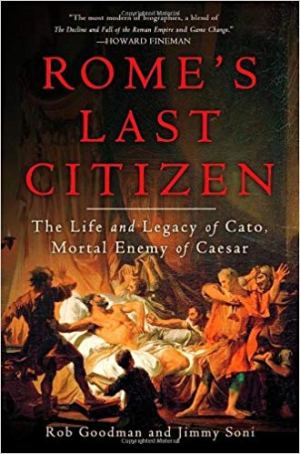
I will send a copy of Rome’s Last Citizen
A copy also goes to whoever suggests a new masthead for this website. “Helping to reignite the spirit of a nation grown cold” shows a hopeful spirit I no longer have.
For More Information
Ideas! See my recommended books and films at Amazon. For something different, see “The Swallow – a story of the WWII Night Witches.”
I highly recommend Martin van Creveld’s new book, Seeing into the Future: A Short History of Prediction

If you liked this post, like us on Facebook and follow us on Twitter. For more information about this vital issue see my posts about fear, about the Constitution, and especially these posts …
- The danger facing America, the names of the guilty, and our best hope for reform.
- Our institutions are hollow because we don’t love them.
- We have become cowards. We can become brave again.
- We gave our rulers the greatest gift that we can give.
- The Founders’ error dooms our Republic, but not the next.
- This post changed everything: A new, dark picture of America’s future.
- Asking what caused our decline and how to fix it.
- A new beginning for America and this website.
Look to the past to see our future
The Founders looked to the Roman Republic for ideas and inspiration. In this time of peril, we too can do so. See two books about the people who were the poles of the forces that could have saved the Republic, but instead destroyed it.
Caesar – a biography by Christian Meier

Rome’s Last Citizen